Implementation
Overview
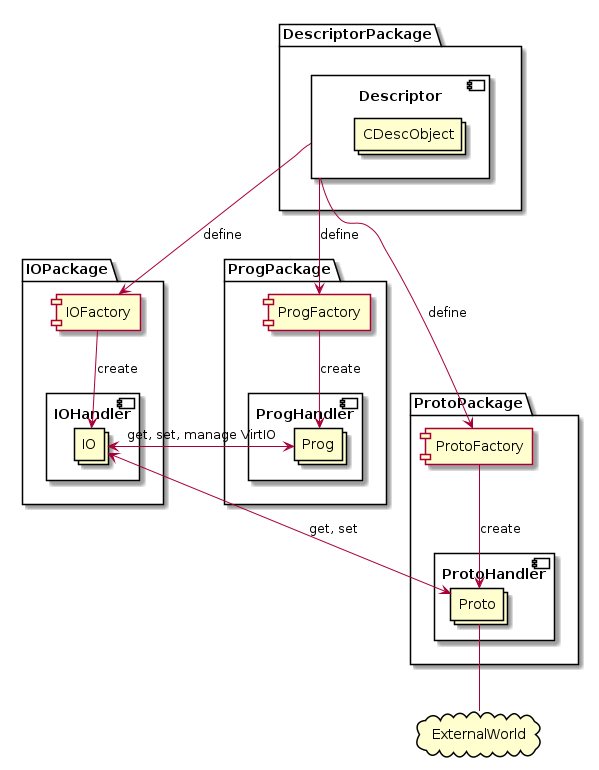
Dawn runtime is descriptor-driven. The descriptor binary defines which objects exist, how they are configured, and how they are connected.
A general implementation view is shown below.
Core Model
The core implementation element is Dawn Descriptor, a binary data array in memory that defines system objects and configuration payloads. Object model details are documented in Dawn Object.
Objects are created by factories from descriptor entries. Dawn uses four object families:
Dawn IO: IO objects read from or write to OS resources and Dawn resources.
Dawn Prog: Program objects process IO data and manage virtual IO data flow.
Dawn Proto: Protocol objects expose IO data to external systems.
Dawn System: System objects configure and switch system facilities (LTE, …); they have no data path, only config and start/stop.
Common runtime utilities and abstractions are in Dawn Common. Porting interfaces are in Porting Layer.
Descriptor source and binary forms are summarized in Descriptor Format. Runtime loading and binary layout details are documented in Dawn Descriptor.
Special IO Components
Some IO classes are framework-facing control/bridge objects:
Virtual IO: virtual IO surface used by program pipelines.
Config IO: runtime get/set path for selected object configuration items.
Control IO: control command path to target objects.
Trigger IO: trigger command path to target objects.
Descriptor IO: descriptor data read access through IO API.
Deployment Patterns
Common device compositions:
IO + PROTO: externally exposed node. Example: remote LED and button.
IO + PROG: edge-processing node. Example: local LED sequencer.
IO + PROG + PROTO: combined processing and external exposure node. Example: filtered sensor over BLE.
Repository Map
Main repository areas:
boards/: board and build configuration directories.Documentation/: documentation sources.dawn/include/: framework public headers.dawn/src/: framework implementation.dawn/apps/: Dawn app entry points.dawn/tests/: unit tests.descriptors/: reusable/example descriptor sources.ntfc/: integration/system test scenarios.tools/dawnpy/: core build/descriptor/tooling CLI.tools/dawnpy-tests/: Dawn QA runner extension.tools/dawnpy-serial/,tools/dawnpy-can/,tools/dawnpy-udp/,tools/dawnpy-modbus/,tools/dawnpy-lwm2m/: protocol-specific tooling extensions.external/nuttx/andexternal/apps/: integrated NuttX trees.
Build Composition
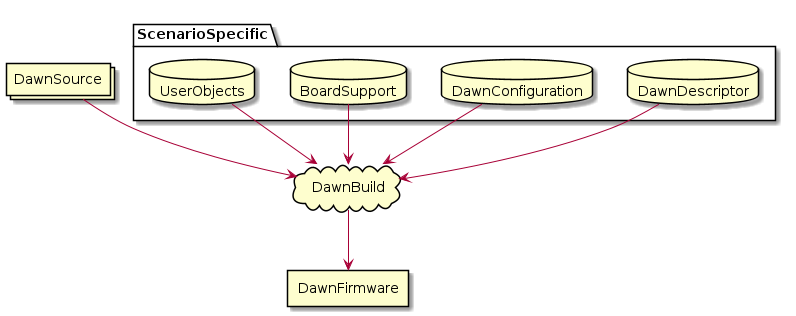
Build inputs:
DawnSource: Dawn framework code.DawnDescriptor: descriptor binary used by the target.DawnConfiguration: scenario and feature configuration.BoardSupport: board/RTOS integration.UserObjects: optional user-provided objects/factories.
Build output:
DawnFirmware: final firmware image.
Components
All IO/PROG/PROTO component pages follow the standardized template in Standardized Component Template.